IZ KRUGA VOJOVODINA and UNFPA conducted multi-year educational work for women with disabilities in local communities. This empowered over a hundred women with various types of disabilities and brought them together in The Initiative of Women with Disabilities Advocating for Their Rights, and led to joint local action.
How Did It All Start
IZ KRUGA VOJVODINA and the United Nations Population Fund (UNFPA) began cooperation in 2018. IZ KRUGA VOJVODINA engaged in data collection and documentation of the level of information women and girls with disabilities have about sexuality, pregnancy, motherhood, and the support they receive in health institutions during gynaecological examinations, pregnancy, giving birth, and raising their children. UNFPA conducted research within the project Autonomy, Voice, and Participation of Persons with Disabilities in Serbia in 2017-2018, realized by a coalition of United Nations agencies as part of the program Partnership on Rights of Persons with Disabilities (UNPRPD).
For the purposes of the research Sexual and reproductive health of women and adolescent girls with disabilities, associates of IZ KRUGA VOJVODINA, in partnership with UNFPA and local organizations, during 2018 conducted ten focus groups for research purposes in Raska, Zajecar, Curug, Novi Becej, Krusevac, Uzice, Vrsac, Belgrade, and two in Novi Sad (one for women with physical disabilities and one for women with intellectual disabilities).

The results of focus groups were promoted in Belgrade, Kragujevac, and Novi Sad. This initiative not only collected and promoted valuable data about the experiences of women with various disabilities from different communities, but it also established ongoing partnerships with many of these women and organizations, supporting their activities, promoting the rights of women with disabilities, their sexual and reproductive rights, health, and protection from violence against women with disabilities.
During 2019 and 2020, IZ KRUGA VOJVODINA and UNFPA carried out several initiatives aimed at enhancing the capacities of women with disabilities for advocacy for their sexual and reproductive rights and protection from violence in cooperation with local organizations in six municipalities (Novi Knezevac, Raska, Temerin, Uzice, Vranje, Valjevo). The work also, in addition to empowering women with disabilities, included: mapping obstacles for fulfilling the sexual and reproductive rights of women with various disabilities; building capacities of health and other professionals, decision makers, and key stakeholders to react better to the needs of women with disabilities and to perform their duties conscientiously. comprehensively, and prejudice-free; motivating local allies to perform actions aiming to improve sexual and reproductive health and rights, and enhanced protection from gender based violence against women with disabilities. Thanks to intensive mentoring support, women with disabilities are empowered to map the existing barriers to the preservation of sexual and reproductive health, to present them to the public and key stakeholders, as well as to implement specific advocacy actions to improve the situation in their local community (see examples of these activities in the media report on the Disability Portal – Public Events on the Reproductive Rights of Women with Disabilities in four Cities of Serbia).
Founding and First Activities of the Initiative of Women with Disabilities Advocating for Their Rights
Co-workers of the IZ KRUGA VOJVODINA, aware of the importance of sharing and transferring the acquired knowledge and experience, not keeping it only in the IZ KRUGA VOJVODINA or in Novi Sad, came up with the idea of being mentors and collaborators and decided along with other women who had trained to address these topics through previously implemented projects to form the Initiative of Women with Disabilities Advocating for Sexual and Reproductive Rights in Serbia (WOMEN’S INITIATIVE) in December 2020.
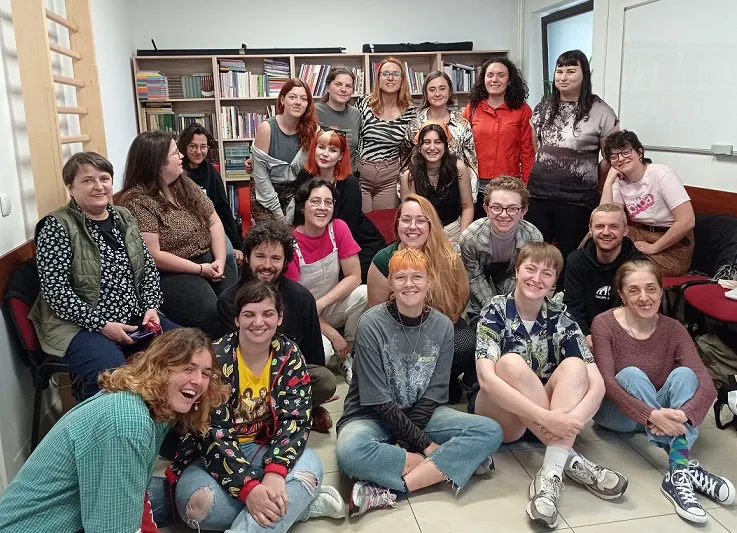
Women’s Initiative assembled 31 women with disabilities from different municipalities. The Initiative worked on the promotion of sexual and reproductive health and rights of women with disabilities, and on protection from gender based violence with coordination and mentorship from IZ KRUGA VOJVODINA and UNFPA. Through these activities, more than 150 women with different types of disabilities raised their advocacy capacities. Then they transferred their knowledge about sexual and reproductive rights and violence against women with disabilities to more than 300 women with disabilities in their communities, and the same number of professionals and decision makers. Numerous advocacy actions led to an increase in the availability and accessibility of services for women with disabilities in many municipalities (Ada, Backa Topola, Belgrade, Cacak, Irig, Kanjiza, Kovin, Kragujevac, Krusevac, Novi Knezevac, Novi Sad, Leskovac, Pancevo, Raska, Ruma, Sremska Mitrovica, Sombor, Temerin, Uzice, Valjevo, Vranje, and Zajecar).
It was very important that women with disabilities who strengthened themselves through training and increased their advocacy capacities later transfer knowledge to other women with disabilities. They also organized advocacy activities with support. This was exactly the goal: to train trainers— i.e. women with disabilities who will be able to lead educational workshops independently. The intention was not to keep knowledge only within members of IZ KRUGA VOJVODINA, but to develop coaching and advocacy skills for other women with different disabilities in other municipalities. Thus, women with disabilities who underwent training in IZ KRUGA VOJVODINA began to train other women with disabilities in other municipalities. For example, Dusica Sretenovic Petrovic from Raska conducted educational workshops in Pancevo. Maja Jović from Temerin led educational workshops for hearing-impaired women from the Association of the Deaf and Hard of Hearing in Kragujevac. Jelena Kostic led a workshop in Ruma with women from the Association of Paraplegics and Quadriplegics… It is also important that they are trained to work not only with women from the community, but also with professionals and decision-makers. They regularly share experiences of women with disabilities, helping to raise their visibility among the community of persons with disabilities, decision-makers, and the wider community. An example of promotional material that makes the experiences of women with disabilities visible is a short film produced by UNPFA in which Maja Jovic, a young hearing-impaired woman from Temerin who graduated from the Academy of Arts, talks about all the prejudices she experienced as a deaf woman when it comes to sexuality and parenting. UNFPA has published a new feature on its website, Get Informed, Smile, Move… You will Succeed! 5 Women You Should Hear about Today. The article highlights women who have demonstrated leadership and made significant contributions in their communities. Each story is different and illustrates how these women took initiative and selected actions that addressed the unique needs of their local areas.
Monika Zunji from Temerin, who is active in local organizations that support persons with disabilities, made a short film about the barriers women with disabilities face when attempting to use services for sexual and reproductive health. The film serves as a basis for discussions in local government. Monika said that taking part in a project helped her leave her comfort zone, overcome the prejudice she had about herself, and become a leader despite having a slurred speech. Women with various disabilities talk about barriers they face, each from their point of view, when they go to gynecological check—ups in the film.
Within a year, Gordana Stojanovic, who lives in Vranje, with other women from her town, managed to return using a hydraulic gynecological table for examinations of women with disabilities and make a film about the obstacles faced by women with disabilities in Vranje when accessing protection services. Their efforts led to the adoption of a local memorandum in Vranje that addresses the needs of women with disabilities during and after the pandemic. During the coronavirus pandemic, certain areas were restricted so that those who were not sick could not even enter. The hydraulic gynecological table remained trapped in one red zone. Thanks to the initiative of women with disabilities from Vranje, the hydraulic gynecological table was successfully returned to the free zone, allowing women to have the necessary examinations again. Women in Vranje also initiated the organization of joint preventive check-ups for women with disabilities. I think that it was during one of these exams that a woman was diagnosed with cancer early, and she was referred for treatment, which ended successfully.
Ana Djokic emphasized that she often had difficulties getting legal information for her family. Sexual and reproductive health used to be a taboo subject. People in her surroundings thought that people with disabilities, like her, shouldn’t have a sexual life. For this reason, women from Uzice attended a session about advocacy for their reproductive rights via the ZOOM platform. For the majority, this was a new experience. In 2020, they successfully commenced a dialogue with local authorities in Uzice about the enhancement of the position of women with disabilities.
Dusica Sretenovic Petrovic from Raska, talked about encountering obstacles every time she went for a gynecologocal check-up. One is that there was no hydraulic table, and because of her disability, it was particularly challenging to access a regular gynecological table. With other women from Raska, Dusica mapped barriers, offered new ideas and initiatives, and advocated with local decision makers to solve problems. Thanks to Dusica’s commitment and her group of women, the local authorities supported the idea of acquiring a hydraulic gynecology table. She later helped secure a hydraulic gynecological table through an additional action for the Health Centre in Raska.
Marija Sofranac from Valjevo, along with other women from the group, attended workshops where she realized that online events add special charm and encouraged them to change things in Valjevo. Women from Valjevo addressed the issue of sexual and reproductive health of women with disabilities for the first time.
We have singled out these five women in this article. However, many other women participated in IZ KRUGA VOJVODINA and UNFPA’s educational workshops and did a lot in their local communities afterwards. We will present their contributions another time.
The Women’s Initiative Plans
Members of the Women’s Initiative believe it is crucial for the voices of women with disabilities to be heard. They are the ones influencing changes, and disability and gender equality policies mustn’t be without their participation. The inclusion of women with disabilities is vital, and to be included, they need to continually work on expanding their knowledge. Regardless of how much women with disabilities are informed, ongoing learning enables their equal participation in policy creation. It is significant that everyone has a good understanding of existing models of disability, is aware of which theoretical framework she advocates for, which terminology she uses, and how others talk about women with disabilities. Knowing the legal framework, both national and international documents signed by the State of Serbia, is vital. It is important that women themselves are reminded, and then they also remind the state to fulfill things it has committed to do. In addition to working in their local communities, it is vital for women to empower themselves to overcome their own prejudices; achieving personal growth through joint work is equally important.
Members of the Women’s Initiative want to increase their capacities, intensify their work, and achieve that by the end of next year, at least one woman with a disability from every municipality in Serbia will be included in the Women’s Initiative. Women with different types of disabilities, united and in greater numbers, continue to work on improving their rights and jointly change their own reality at the local and national levels.