Access to justice is one of the cornerstones of the rule of law and a fundamental human right. Yet for many persons with disabilities, the right to seek justice is limited not by the law itself, but by inaccessible institutions, communication barriers and the lack of reasonable accommodation.
A study published in Humanities and Social Sciences Communications offers the first comprehensive quantitative assessment of accessibility across Serbia’s judicial institutions. The findings reveal that while Serbia has made progress in developing its legal framework on disability rights, significant structural barriers continue to prevent many persons with disabilities from exercising their right to equal access to justice.
Beyond Physical Accessibility
Accessibility is often understood primarily as the removal of architectural barriers. However, modern human rights standards, particularly the UN Convention on the Rights of Persons with Disabilities (CRPD), define accessibility much more broadly.
Access to justice includes accessible information, effective communication, procedural accommodations, reasonable adjustments and the ability of every individual to participate equally in legal proceedings regardless of the type of disability.
The Serbian study embraces this broader understanding. Rather than focusing solely on the physical accessibility of court buildings, the researchers examined whether judicial institutions provide adapted services, implement accessibility measures, train their staff, cooperate with organizations of persons with disabilities and understand the legal standards governing accessibility.
A Nationwide Picture of the Serbian Judiciary
The research analyzed responses from 233 judicial institutions across Serbia, including courts, public prosecutor’s offices and other justice-sector bodies. Instead of examining only individual examples, it provides a nationwide overview of institutional accessibility.
The overall picture is concerning.
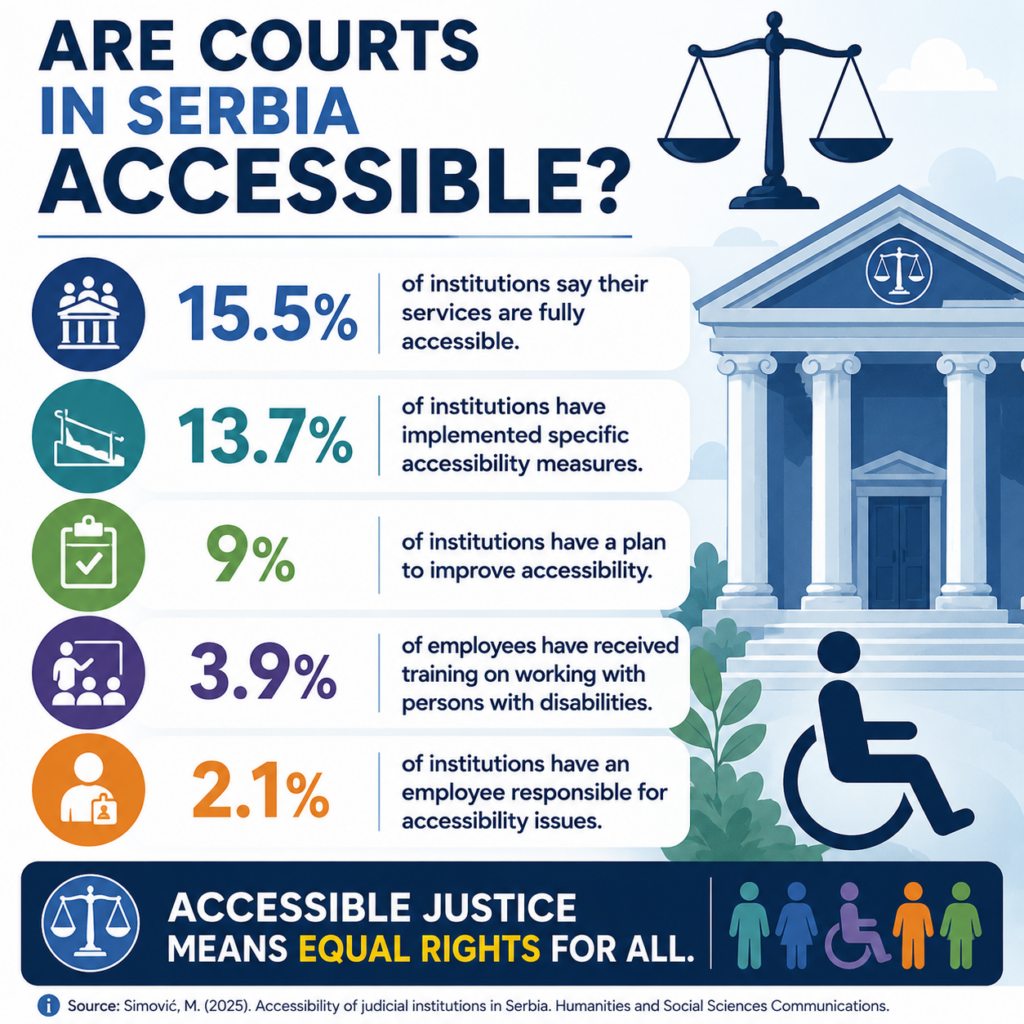
Only 15.5% of surveyed institutions reported that their legal services were fully adapted for persons with disabilities. More than half considered their services only partially adapted, while a significant proportion acknowledged that they had not adapted their services at all. Equally worrying, only 9% of institutions reported having any plan or strategy to improve accessibility in the future.
These findings suggest that accessibility challenges are not isolated incidents affecting a few institutions. Instead, they reflect systemic shortcomings across the Serbian judicial system.
Accessibility Is Also a Question of Knowledge
Perhaps the study’s most interesting finding is that accessibility depends not only on financial resources or building reconstruction.
The researchers found that institutions familiar with public accessibility standards were almost three times more likely to provide accessible legal services. Institutions that had already implemented concrete accessibility measures were over five times more likely to report adapted services.
This suggests that institutional knowledge plays a crucial role. Understanding accessibility standards is not merely a legal obligation – it directly influences everyday practice.
Unfortunately, awareness remains limited.
Only around one-third of surveyed institutions reported being familiar with accessibility standards for public buildings, while just over one quarter stated that they were familiar with Serbia’s national legal framework concerning accessibility for persons with disabilities.
These figures raise an important question: if institutions responsible for protecting citizens’ rights are themselves insufficiently familiar with accessibility obligations, how can they consistently guarantee equal access to justice?
Accessibility Requires More Than Infrastructure
The study also highlights several institutional weaknesses that receive less public attention than architectural barriers.
Only 13.7% of institutions reported implementing specific accessibility measures. Merely 3.9% had employees who had completed disability-related training. Only 8.6% cooperated with organizations of persons with disabilities, while just 2.1% had a staff member specifically responsible for disability-related issues. Employees with disabilities were present in only 16.3% of participating institutions.
Taken together, these findings indicate that accessibility has not yet become an integral part of institutional culture within Serbia’s justice system.
Why Serbia’s Experience Matters
Although this research focuses on Serbia, its implications extend beyond one country.
Many states have adopted disability legislation and ratified the CRPD, yet implementation remains uneven. The Serbian findings illustrate a challenge frequently observed across Europe and elsewhere: legal guarantees alone do not automatically create accessible public institutions.
The study also demonstrates that relatively modest institutional changes—such as staff training, familiarity with accessibility standards and systematic planning—can significantly improve service accessibility.
This is particularly relevant for countries currently reforming their justice systems or implementing CRPD obligations.
Access to Justice as a Human Rights Issue
The findings should also be viewed within the broader context of disability rights developments in Serbia.
Over the past decade, organizations of persons with disabilities have consistently advocated for greater accessibility, reasonable accommodation and equal participation across all areas of public life. Issues such as independent living, supported decision-making, access to information and inclusive public services have increasingly become part of national policy discussions.
Nevertheless, practical implementation often remains inconsistent.
The justice system illustrates this broader pattern. While the legal framework generally reflects international standards, institutional capacity, professional awareness and available resources continue to vary considerably.
The study therefore provides empirical evidence supporting concerns that disability organizations in Serbia have raised for many years: accessibility cannot be achieved solely through legislation.
An Encouraging Finding
Among the study’s more encouraging results is the finding that institutions receiving requests for accessibility adaptations were significantly more likely to introduce concrete accessibility measures.
This suggests that dialogue between judicial institutions and persons with disabilities can produce tangible improvements.
It also underlines the importance of disability organizations, legal advocacy and rights awareness. When persons with disabilities know their rights and actively request reasonable accommodation, institutions appear more willing to respond.
Looking Forward
The authors conclude that improving accessibility requires a combination of policy commitment, institutional leadership and practical implementation.
Their recommendations include systematic staff training, increased investment in accessible facilities and services, stronger cooperation with organizations of persons with disabilities and greater awareness of accessibility standards throughout the judicial system.
Ultimately, access to justice is not simply a technical matter of ramps, elevators or accessible entrances.
It is about whether every person—regardless of disability—can understand legal proceedings, communicate effectively, participate equally and exercise their rights without discrimination.
Serbia’s experience demonstrates that meaningful accessibility requires more than legal compliance. It requires institutions that recognize accessibility as an essential component of justice itself.
The newly published study provides an important evidence base for that transformation. It not only identifies the existing barriers but also points towards practical solutions that could strengthen equal access to justice—not only in Serbia, but in other countries facing similar challenges.
About English Corner
English Corner is a curated section of the Disability Portal featuring selected articles on disability rights, inclusive policies, research, legislation and innovative practices from Serbia. Its purpose is to make relevant developments accessible to an international audience and to contribute to the global exchange of knowledge on disability from a human rights perspective.